ReadMeAI
Full-stack SaaS that turns a plain-English project description into a production-ready README in seconds — powered by Claude AI.
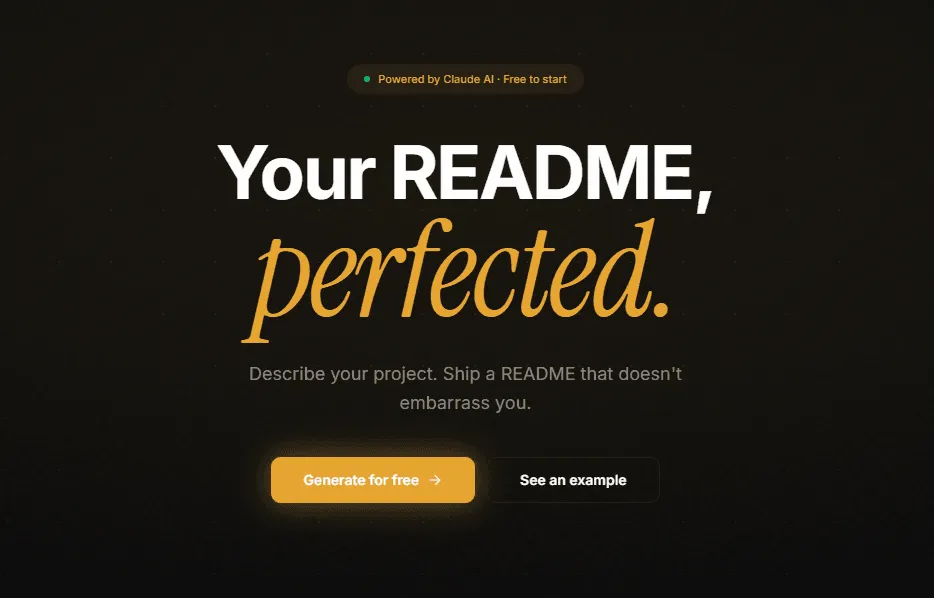
MISSION BRIEF
Built a full-stack SaaS app that takes a plain-English project description and generates a polished, production-ready README in seconds using Claude AI. Integrated Clerk for multi-tenant authentication and Stripe for subscription billing. The backend is an Express + MongoDB REST API that handles prompt orchestration, usage metering, and plan enforcement. The React + TypeScript frontend provides a live markdown preview with one-click export.
THE PROBLEM
Most side projects ship with a missing or one-line README, because writing a good one is tedious: badges, install steps, usage examples, contributing notes. I wanted a tool that turns a plain-English description of a project into a complete README in seconds, and I wanted to build it as a real SaaS with accounts, usage limits, and billing, not just a prompt in a text box.
APPROACH
Users describe the project, list the tech stack, and pick a template: Standard, CLI Tool, npm Package, or Monorepo. Each template adds its own instructions, such as a flags table for CLI tools, function signatures for npm packages, or a package tree for monorepos. Generation runs on Claude (Haiku 4.5) with a fixed system prompt that requires a consistent structure: badges, description, features, tech stack, prerequisites, installation, usage with a real code example, contributing, and license. It also forbids placeholder text like "[Your Name]", so the output is usable without editing.
ARCHITECTURE
React, TypeScript, and Vite on the frontend, with a live Markdown preview and one-click export. An Express and TypeScript API handles generation, checkout, user, and Stripe webhook routes, deployed as a serverless function on Vercel. Clerk handles authentication. Every API request carries a Clerk JWT that middleware verifies, and the server checks that the token's user matches the request. MongoDB (Mongoose) stores users and a record of each generation. The free plan allows one README per calendar month, the counter resets on the first request of a new month, and Stripe Checkout plus webhooks move a user to the $7/month Pro plan.